Ferries from Lavrio: Kéa, Kythnos & the quieter Cyclades
Almost everyone heads to Piraeus for the islands. Kéa (Tzia) doesn’t sail from there at all: it leaves only from Lavrio, a small working harbour on the south Attica coast, as do the easiest crossings to Kythnos and the western Cyclades.
It is the detail nearly every island-hopping plan gets wrong: Kéa (Tzia) is reached only from Lavrio, never from Piraeus or Rafina. An itinerary built on Piraeus “for the Cyclades” has quietly skipped the nearest one.
Lavrio sits on the south-east corner of Attica: roughly an hour’s drive from central Athens, 40 minutes from Athens Airport, and half an hour from the Kleos above Anavyssos. For Kéa, Kythnos and the quieter western Cyclades it is the closest and least-crowded port, close enough that a spontaneous Kéa day trip is on the table.
| Route | Crossing | Foot fare* | Summer frequency |
|---|---|---|---|
| Lavrio → Kéa (Tzia) | ≈ 1 hour (fastest ≈ 40 min) | ≈ €11–16 | Up to 7–8 a day |
| Lavrio → Kythnos | ≈ 1–2 hours by vessel | Similar range | Up to 5–6 a day |
| Car supplement | ≈ €34 on top | ||
| Port parking | ≈ €6–7 / day |
*Fares as of June 2026; confirm before you book.
The operators & the crossings
Three conventional lines work the Lavrio → Kéa → Kythnos route year-round, each with a single ferry. Goutos Lines runs the F/B Makedon, a family company with roughly half a century on the route and typically three to five departures a day. Karystia sails the F/B Marmari Express, and Triton Ferries the F/B Ionis. In peak summer a seasonal operator can surface on the Kéa run, so treat the live timetable as the truth.
Crossings from Lavrio (summer)
| Kéa (Tzia): up to ~7–8 daily in high season | ≈ 1 hr |
| Kythnos (Merichás): up to ~5–6 daily in summer | ≈ 1–2 hr |
| Western Cyclades: Serifos, Sifnos, Milos | select / seasonal |
For the headline Cyclades (Mykonos, Santorini, Naxos, Paros), the bigger gateways are Piraeus (everything, most frequent) and Rafina (Mykonos, Tinos, Andros). Summer (June–September) frequencies run far higher than the rest of the year.
Beyond Kéa and Kythnos, select, seasonal sailings push further into the western Cyclades (Serifós, Sífnus, Mílos, and on to Sýros and Kímolos) by conventional ferry or fast catamaran. Lavrio even links the North Aegean (Límnos, Ágios Efstrátios, Kavála) on a long-haul winter line. Neither runs to a fixed daily pattern; check current timetables before planning around them.
Fares & booking
Fares shift by season and operator, so check current prices before you commit. Book on the operator sites, through Ferryhopper and the other aggregators, or with the travel agents at Lavrio port; the port info line is +30 22850 22500.
Foot passenger or take the car?
For Kéa, walk on unless you have a firm reason not to. The foot fare is a fraction of the car fare, the crossing is short, and the near-port beaches and the hill-town climb need no driving. Bring the car only for the far southern beaches, a stay of several nights, or companions who can’t manage steep village lanes. Kythnos is more car-friendly, its good beaches spread out, but vehicle space sells out long before deck tickets in August. No need to sleep aboard on these short hops; cabins matter only on the long-haul northern line.
Summer vs winter: the reality
Those frequencies are the high-summer picture. Outside that window the timetable thins. Kéa stays served year-round (it has no other port, so it can’t be dropped), but Kythnos and especially the western-Cyclades and northern-Aegean links fall to a few sailings a week, or pause altogether. One rule saves a stranded evening: on any off-season or last-boat plan, confirm the same-day return exists before you leave the mainland.
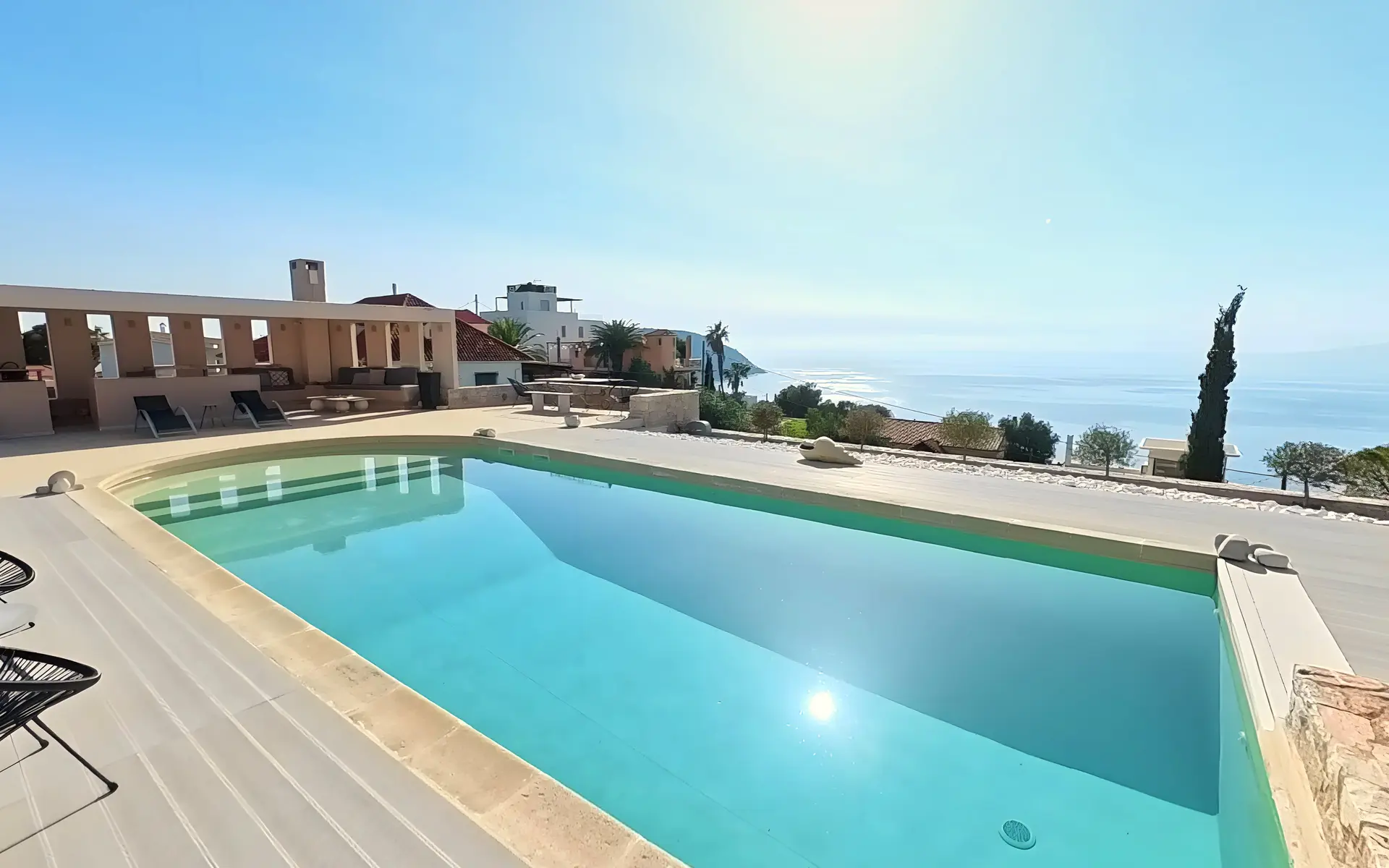
A morning boat out, an evening boat back.
A day on Kéa, and home by sunset
The nearest Cycladic island to Athens never went the way of Mykonos or Santorini. What you get is the older Cyclades: oak-shaded footpaths, a car-free hilltop town, and swimming bays you might have largely to yourself. Lock down one number before you leave, the return sailing; everything else on Kéa is forgiving, but the last boat is not.
Morning: the ferry lands at Korissia (also written Livadi), Kéa’s main and only port: a taverna seafront in the sheltered bay of Agios Nikolaos on the northwest coast. Roughly five or six kilometres uphill, Ioulida is the island’s amphitheatrical hill capital: whitewashed houses, stepped car-free lanes, and a small Archaeological Museum of Cycladic figurines and finds from ancient Agia Irini and Karthaia. Its hours are short, seasonal and unreliably posted online, so check on the day.
Just below the town, an old stone kalderími drops to the Lion of Kéa in ten to twenty minutes on foot. Carved into the living bedrock around 600 BC, it is one of the oldest surviving works of Greek monumental sculpture. Up to roughly eight metres long, faint almost-smile intact, it stares out over the valley. The walk back is the steeper half; wear real shoes and carry water in summer.
Afternoon: a swim in a quiet bay. Gialiskari, a small sandy cove barely a kilometre from the port, with palm and eucalyptus shade and a couple of tavernas, is the easiest on foot. Otzias, the island’s longest beach at around 700 metres of sand in a sheltered north-coast bay, is a short hop further on. Expect salt-cedar shade, shallow water and a taverna or two; partly organised, it’s the better bet for a sunbed. Then a long lunch at Vourkari, the fishing-and-yachting village just north of the port, or back at Korissia. For the splurge, Aristos has been on the Vourkari seafront since the 1970s, run by the founder’s family and known for its astakomakaronáda (lobster spaghetti) and the fish of the day chosen at the counter. It isn’t cheap; that’s the point.
Evening: the ferry back to Lavrio with the light going gold over the gulf, then the short drive along the coast. Basing on the Anavyssos coast, where we’d anchor the day, you’re home well before dark.
Getting around the island
A local bus timed to the ferries runs from the Korissia ramp up to Ioulida and across to Otzias, useful but limited; check the posted timetable when you land. The island keeps only a handful of taxis, so pre-book if you’ll need one. For the southern coast, where well-protected tamarisk-shaded Koundouros sits a good drive away, the practical answer is a rental car or your own brought across on the ferry. Rather watch the wake than the road? A private boat from Lavrio also reaches Kéa’s coves.
Kéa is doable as a day, but it rewards an overnight. Port, town, Lion and a swim near Korissia fit comfortably between boats; the far southern beaches and ancient Karthaia turn a single day tight. If yours is tight, skip the far south.
The port town itself
Lavrio is no tourist set-piece; it’s a working harbour, which is the appeal. The catch lands at the town fish market in the mornings, liveliest at weekends, so go early, and a row of old-school tavernas sits where the boats unload. Under it all lies a history most people never suspect: the ancient silver mines here funded the Athenian navy that won at Salamis. Worth half an hour even if you’re only here for a boat, and the hill above it an hour more.
The hill that built a navy
On the Velatouri hill just north of the port stands the theatre at Thorikos. Not, as the listicles overstate, “the oldest theatre in the world”, but one of the oldest known stone theatres anywhere, built at the end of the Archaic period, around 525–480 BC. It doesn’t look like the theatres you know. Instead of a neat semicircle, its seats run straight through the middle and curve only at the ends, around an elongated orchestra some 16 by 30 metres. It seated up to around 3,000–3,200, doubled as the meeting place of the local deme, and kept a small temple to Dionysos beside the orchestra. It was the heart of Thorikos, an ancient mining town built on what lay under the hill: silver.
The mines of Laurion were the most important mining region of ancient Greece in the 5th and 4th centuries BC. Mining on the hill goes back some five thousand years, to around 3200 BC. Silver was worked intensively from the 6th century BC, down shafts as deep as 100 metres and through cramped, low galleries lit by oil lamp. The work fell overwhelmingly to enslaved people in brutal conditions, as many as 20,000 by the count of Thucydides. The famous moment came in 483/482 BC: a rich new vein, and Themistocles’ urging to spend the windfall not on a per-citizen handout but on a war fleet of up to 200 triremes, per Herodotus. Two years later that fleet broke the Persians at Salamis, in the very stretch of the Saronic Gulf the house looks out over.
Today Thorikos is an open archaeological site and entry is free. The theatre is the set piece; the rest is the hill itself: the ore-washing tables and processing floors where silver-bearing rock was crushed and rinsed and, higher up, the mouths of old mine shafts. Allow roughly 45 to 60 minutes for the theatre and a wander up the slope. Bring sturdy shoes and water; there’s no shade and no kiosk. One caveat as of June 2026: the fenced part keeps limited, seasonal opening hours and has no ticket booth, so confirm ahead or arrange access through the Archaeological Museum of Lavrion. The unfenced hill and washeries are walkable freely. Stitch it together with the harbour, a ferry day, or Cape Sounion for a full day of the coast’s deep history, almost without crowds.
Before you sail: check the live timetable; fares and frequencies shift by season. Confirm the same-day return if you’re day-tripping, and walk on rather than take the car unless you really need it. Vessel names, fares and sailing counts here were last checked June 2026.
Good to know
Is Lavrio really the only port for Kéa?
Yes. Kéa (Tzia) is reached only from Lavrio; nothing sails to it from Piraeus or Rafina at all.
Which operators run the Lavrio crossings, and which is best?
Goutos Lines (F/B Makedon), Karystia (F/B Marmari Express) and Triton Ferries (F/B Ionis) work Lavrio → Kéa → Kythnos year-round. None is clearly "best": they share the route and fares are close, so book whichever sailing time suits. A seasonal operator can join the Kéa run in high summer.
What do the Kéa and Kythnos crossings cost, and where do you book?
As of June 2026, foot fares to Kéa run around €11–16, Kythnos similar, a car roughly €34 more; prices shift by season and operator. Book on operator sites, through Ferryhopper, or with the travel agents at Lavrio port. Quay parking runs about €6–7 a day.
Can you do Kéa as a day trip, or should you stay overnight?
Doable as a day: about an hour by ferry, and the port, the climb to Ioulida and the Lion, and a near-port swim all fit. But it rewards an overnight, when the far southern beaches and a slow harbour dinner come into reach. Either way, confirm the same-day return first; off-season the service thins right out.
What is there to do on Kéa in a day?
Wander car-free Ioulida and its small Archaeological Museum, walk down to the Lion of Kéa, swim at Gialiskari by the port or sandy Otzias, and have lunch by the water at Vourkari or Korissia. It’s an island for a slow day, not a checklist.
Do ferries to Aegina, Mykonos or Santorini leave from Lavrio?
No. Aegina and the Saronic islands (Poros, Hydra) sail from Piraeus; Mykonos, Tinos and Andros from Rafina. Lavrio is the nearest port for Kéa, Kythnos and the quieter western Cyclades, and the only one for Kéa.
How do you visit the Thorikos theatre, and is there a fee?
Free, with no ticket booth. As of June 2026 the fenced theatre keeps limited, seasonal opening hours: confirm before setting out, or arrange access through the Archaeological Museum of Lavrion. The unfenced hill (ore-washing remains, shaft mouths) can be walked freely. Park on the road near the site; bring water and proper shoes, as there’s no shade or kiosk.
More from the area
Basing on the south coast puts this port about half an hour away, handy if you want islands without the Piraeus haul.